


Custom Canted Coil Springs
Ivex designs and manufactures custom canted coil springs for electrical contacts, EMI/RFI shielding, spring-energized seals, grounding, mechanical locking, latching, and precision retention applications.
Their canted coil geometry provides a relatively flat force-deflection response within a defined working range, helping accommodate dimensional variation while maintaining controlled spring force. Spring dimensions, load, material, plating, and axial or radial configuration can be customized to suit specific mechanical and electrical requirements.

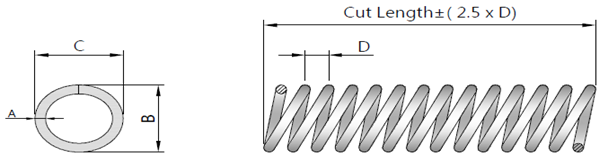
| Item No. | Metrics(mm) | Inches(") | |||||||
| A | B | C | D | A | B | C | D | ||
| SS-PC132 | L | 0.08 | 0.64 | 0.69 | 0.18 | 0.003 | 0.025 | 0.027 | 0.007 |
| SS-PC132 | M | 0.09 | 0.64 | 0.69 | 0.20 | 0.0035 | 0.025 | 0.027 | 0.008 |
| SS-PC132 | MH | 0.11 | 0.66 | 0.71 | 0.23 | 0.0045 | 0.026 | 0.028 | 0.009 |
| SS-PC132 | H | 0.13 | 0.66 | 0.71 | 0.25 | 0.005 | 0.026 | 0.028 | 0.010 |
| SS-PC000 | L | 0.13 | 1.40 | 1.52 | 0.33 | 0.005 | 0.055 | 0.060 | 0.013 |
| SS-PC000 | LM | 0.15 | 1.40 | 1.52 | 0.36 | 0.006 | 0.055 | 0.060 | 0.014 |
| SS-PC000 | M | 0.18 | 1.30 | 1.42 | 0.41 | 0.007 | 0.051 | 0.056 | 0.016 |
| SS-PC000 | H | 0.20 | 1.22 | 1.32 | 0.46 | 0.008 | 0.048 | 0.052 | 0.018 |
| SS-PC100 | L | 0.20 | 2.18 | 2.39 | 0.51 | 0.008 | 0.086 | 0.094 | 0.020 |
| SS-PC100 | M | 0.28 | 2.11 | 2.29 | 0.58 | 0.011 | 0.083 | 0.090 | 0.023 |
| SS-PC100 | H | 0.36 | 2.06 | 2.26 | 0.71 | 0.014 | 0.081 | 0.089 | 0.028 |
| SS-PC200 | L | 0.28 | 2.92 | 3.15 | 0.69 | 0.011 | 0.115 | 0.124 | 0.027 |
| SS-PC200 | M | 0.36 | 2.90 | 3.10 | 0.69 | 0.014 | 0.114 | 0.122 | 0.027 |
| SS-PC200 | H | 0.41 | 2.87 | 3.10 | 0.79 | 0.016 | 0.113 | 0.122 | 0.031 |
| SS-PC300 | L | 0.41 | 4.14 | 4.50 | 0.91 | 0.016 | 0.163 | 0.177 | 0.036 |
| SS-PC300 | M | 0.51 | 4.14 | 4.47 | 1.14 | 0.020 | 0.163 | 0.176 | 0.045 |
| SS-PC300 | H | 0.66 | 4.04 | 4.37 | 1.42 | 0.026 | 0.159 | 0.172 | 0.056 |
| SS-PC400 | L | 0.51 | 5.46 | 6.05 | 1.22 | 0.020 | 0.215 | 0.238 | 0.048 |
| SS-PC400 | M | 0.66 | 5.46 | 5.99 | 1.50 | 0.026 | 0.215 | 0.236 | 0.059 |
| SS-PC400 | H | 0.79 | 5.46 | 5.84 | 1.68 | 0.031 | 0.215 | 0.230 | 0.066 |
| SS-PC500 | L | 0.66 | 8.26 | 9.19 | 1.50 | 0.026 | 0.325 | 0.362 | 0.059 |
| SS-PC500 | M | 0.79 | 8.26 | 9.12 | 1.73 | 0.031 | 0.325 | 0.359 | 0.068 |
| SS-PC500 | H | 1.04 | 8.26 | 8.84 | 2.21 | 0.041 | 0.325 | 0.348 | 0.087 |
| Material | ‧ 301SS-Standard | Plating | ‧ Silver | ||
| ‧ 316SS | ‧ Gold | ||||
| ‧ 17/7PH | ‧ Nickel | ||||
| ‧ Elgiloy | ‧ Tin | ||||