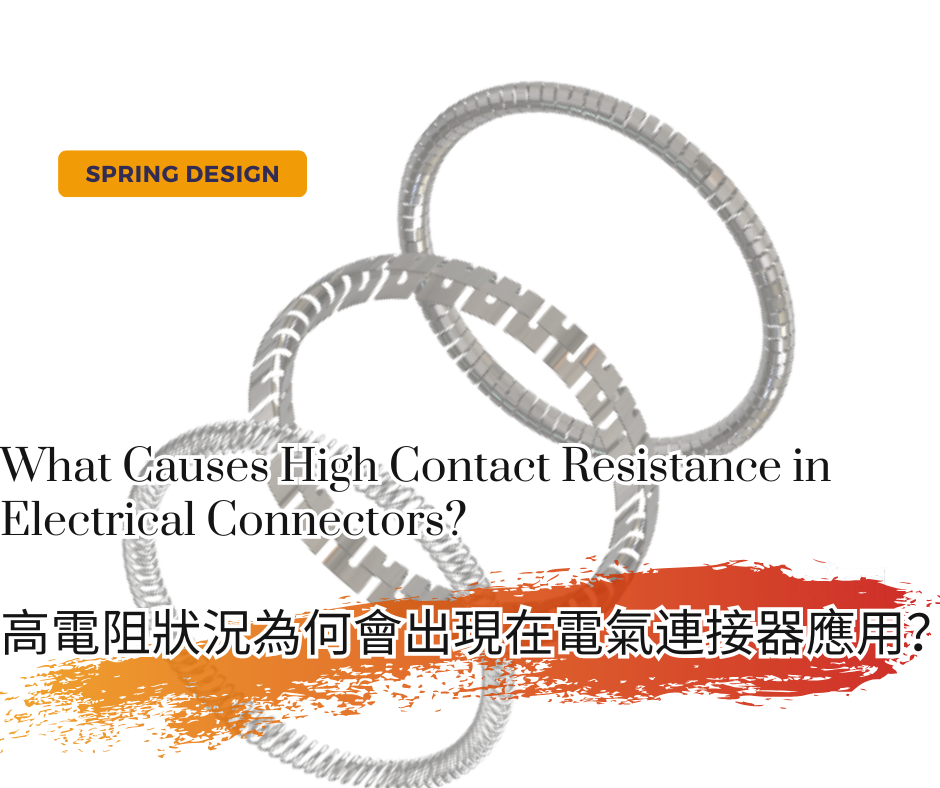
What Causes High Contact Resistance in Electrical Connectors?
What Causes High Contact Resistance in Electrical Connectors?
In modern electrical systems, maintaining low and stable contact resistance is critical for performance, efficiency, and long-term reliability. From EV battery systems to industrial connectors and power distribution units, even small increases in contact resistance can lead to overheating, energy loss, and system failure.
Yet in real-world applications, many connector designs experience rising contact resistance over time.
Understanding the root causes of this issue is the first step toward designing more reliable electrical interfaces.
What Is Contact Resistance?
Contact resistance refers to the resistance at the interface where two conductive surfaces meet. Unlike bulk material resistance, it is heavily influenced by surface conditions, contact force, and environmental factors.
Even when two metal surfaces appear to be in full contact, microscopic irregularities mean that actual electrical conduction occurs only at small contact points (asperities).
This makes contact resistance highly sensitive to mechanical and environmental changes.
Why High Contact Resistance Matters
Increased contact resistance can result in:
- Localized heating (hot spots)
- Energy loss and reduced efficiency
- Signal instability or voltage drop
- Accelerated material degradation
- Risk of thermal runaway in high-current systems
For high-power or mission-critical applications, these effects can lead to premature system failure.
Key Causes of High Contact Resistance
1. Insufficient or Unstable Contact Force
Contact force directly determines how effectively two conductive surfaces engage.
If the force is too low or inconsistent:
- Actual contact area decreases
- Electrical resistance increases
- Intermittent contact may occur
In many cases, traditional spring designs cannot maintain stable force over time, especially under vibration or thermal cycling.
2. Surface Oxidation and Contamination
Over time, contact surfaces are exposed to:
- Oxidation (especially in non-noble metals)
- Dust, moisture, and airborne contaminants
- Residue from manufacturing or handling
These layers act as insulating barriers, increasing resistance at the interface.
3. Fretting Wear from Micro-Motion
In dynamic environments, even microscopic movement between contact surfaces can cause fretting wear.
This leads to:
- Removal of protective surface layers
- Generation of debris
- Oxidation of exposed material
Fretting is one of the most common causes of rising contact resistance in connectors exposed to vibration.
4. Thermal Expansion and Material Mismatch
Different materials expand and contract at different rates when exposed to temperature changes.
This can result in:
- Loss of contact pressure
- Formation of micro-gaps
- Fluctuating electrical performance
Without proper compliance in the design, thermal cycling can significantly degrade contact reliability.
5. Poor Tolerance Control and Assembly Variation
Manufacturing tolerances affect how components fit together.
If not properly managed:
- Contact force varies between units
- Some connectors may be underloaded
- Performance becomes inconsistent
This issue is often overlooked during early design stages.
6. Material Fatigue and Spring Relaxation
Over time, mechanical components responsible for maintaining contact force—such as springs—can degrade.
This results in:
- Reduced force output
- Permanent deformation
- Loss of contact integrity
Fatigue is especially critical in applications involving repeated cycles or continuous load.
The Hidden Factor: Spring Design
While many engineers focus on contact materials or plating, the spring mechanism behind the contact interface is often the deciding factor in long-term performance.
An inadequate spring design can lead to:
- Force instability
- Poor tolerance compensation
- Increased susceptibility to vibration
- Reduced fatigue life
This is why spring selection plays a critical role in connector reliability.
How Advanced Spring Designs Reduce Contact Resistance
Canted Coil Springs
Canted coil springs provide near-constant force across a defined deflection range.
Benefits include:
- Stable contact force under vibration
- Multi-point contact for improved conductivity
- Effective tolerance compensation
- Support for EMI shielding and grounding
These characteristics make them ideal for high-reliability electrical connectors.
Helical Springs
Helical springs offer predictable force behavior and strong fatigue performance.
They are suitable for:
- Load control applications
- Supporting repeated mating cycles
- Mechanical buffering
When properly designed, they help maintain consistent contact force over time.
Cantilever Springs
Cantilever springs are effective in compact and precision applications.
Advantages:
- Fast response to small deflections
- Space-efficient design
- Support for stable positioning
They are often used to stabilize contact interfaces and reduce micro-motion.
Designing for Low and Stable Contact Resistance
To minimize contact resistance in connector systems, engineers should consider:
- Maintaining consistent and sufficient contact force
- Selecting appropriate materials and surface treatments
- Designing for vibration and thermal expansion
- Controlling manufacturing tolerances
- Choosing the right spring technology for the application
A system-level approach is essential for long-term reliability.
How Ivex Supports Reliable Electrical Contact Design
Ivex provides engineered spring solutions that address real-world connector challenges.
Capabilities include:
- Custom canted coil springs for electrical contact and EMI applications
- Precision helical springs for fatigue and load control
- High-performance cantilever springs for compact systems
- Force-deflection analysis and simulation
- Material selection (stainless steel, BeCu, Elgiloy®)
- High-consistency manufacturing with tight tolerance control
By working closely with engineering teams, Ivex helps ensure stable contact performance across real operating conditions.
Conclusion
High contact resistance in electrical connectors is rarely caused by a single factor. It is typically the result of combined mechanical, environmental, and material-related issues.
Among these, maintaining stable contact force—through proper spring design—is one of the most critical yet often overlooked elements.
By understanding the root causes and selecting the right spring technology, engineers can significantly improve connector performance and reliability.
If you are experiencing issues with contact resistance or connector reliability, Ivex can help.
Contact Ivex to explore custom spring solutions designed for stable electrical performance in demanding environments.