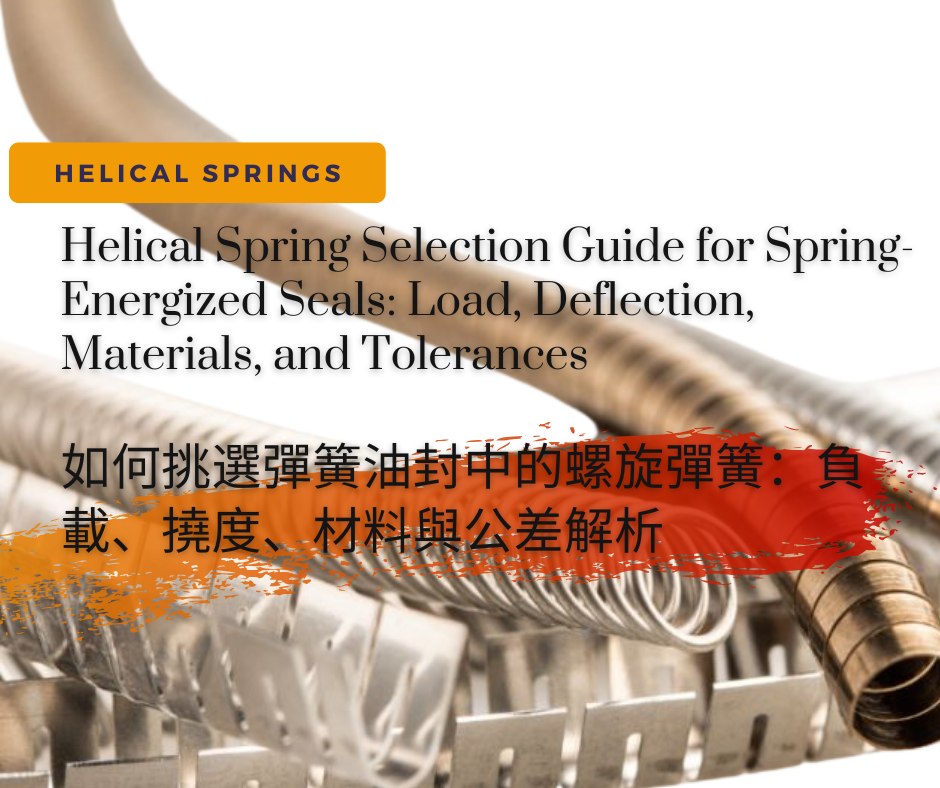
Helical Spring Selection Guide for Spring-Energized Seals: Load, Deflection, Materials, and Tolerances
Helical Spring Selection Guide for Spring-Energized Seals: Load, Deflection, Materials, and Tolerances
In spring-energized seals, the energizer defines how the seal performs under pressure, temperature changes, wear, and long-term cycling. Among all energizer options, the helical spring, a continuous wound coil that maintains a uniform radial load, remains one of the most dependable choices for demanding applications. Engineers choose helical spring energizers when they need predictable load distribution, stable deflection behavior, and reliable sealing performance over long service life.
But selecting the right helical spring is far from a one-step decision. Small variations in wire size, alloy selection, coil geometry, stress level, and dimensional tolerance can significantly affect the seal's friction, extrusion resistance, service temperature, ability to recover under thermal cycling, and compatibility with pressure changes.
This guide provides a detailed look into how to select the appropriate helical spring energizer, covering four core engineering principles:
-
Spring Load
-
Deflection Behavior
-
Material Selection
-
Manufacturing Tolerances
It is designed for sealing engineers, mechanical designers, and manufacturers working with PTFE seals, spring seals, valve seals, cryogenic seals, and precision sealing systems across aerospace, semiconductor, chemical processing, and energy industries.
1. Understanding Spring Load: The Foundation of Seal Performance
A helical spring energizer applies a continuous radial load on the sealing lips. This load compensates for thermal expansion, material deformation, wear, and pressure cycling. Choosing the correct load level is crucial because it directly affects:
-
Initial sealing force
-
Breakaway friction
-
Seal wear rate
-
Ability to maintain contact in low-pressure or vacuum applications
-
Extrusion resistance at higher pressures
1.1 Light, Medium, or High Spring Loads
Most spring-energized seal manufacturers classify helical springs into three general load categories:
| Load Level | Typical Uses |
|---|---|
| Light Load | Low friction sealing, vacuum systems, delicate instruments, static seals |
| Medium Load | General-purpose dynamic sealing, pumps, compressors, processing equipment |
| High Load | High-pressure fluids, large cross-section seals, aggressive media, extrusion-critical environments |
Higher loads improve contact pressure but may increase friction, energy consumption, and heat generation—especially in high-speed rotary systems. Conversely, light loads reduce friction but may not maintain adequate sealing force under pressure or misalignment.
Engineers must balance sealing reliability with acceptable frictional behavior.
2. Deflection: How the Spring Responds to Movement, Wear, and Thermal Cycling
Deflection is the amount a spring can compress or recover while maintaining force within an acceptable range. Helical springs exhibit predictable linear (or near-linear) deflection, making them easier to model and more consistent than elastomeric energizers.
2.1 Why Deflection Matters in Seals
The energizer must accommodate:
-
Seal lip wear over time
-
Dimensional changes due to temperature
-
Out-of-round hardware
-
Pressure fluctuations
-
Misalignment or shaft runout
If the spring does not have enough deflection range, sealing force drops quickly as conditions shift. If it deflects too easily, the seal may not withstand pressure.
2.2 Common Deflection Targets
Many designers look for springs that operate within 20–40% of their total deflection range in normal working conditions. This ensures:
-
Reserve force for thermal shrinkage
-
Adequate compliance to follow shaft movement
-
Consistent friction behavior
2.3 Wire Size and Coil Geometry
Deflection capability is influenced by:
-
Wire diameter
-
Pitch
-
Inner and outer coil diameters
-
Number of active coils
-
Spring index (coil diameter / wire diameter)
A larger wire diameter increases load but reduces deflection. A tight coil pitch increases load but limits compliance. Engineers often adjust these parameters to control friction versus sealing power.
3. Material Selection: The Role of Alloy in Performance and Durability
Helical springs for sealing differ from common mechanical springs because they must survive:
-
Corrosion
-
Temperature extremes
-
Chemical exposure
-
Vacuum and cryogenic conditions
-
Mechanical cycling in dynamic seals
Choosing the wrong alloy can shorten seal life or lead to load loss.
3.1 Common Alloys Used in Helical Seal Springs
Below are the most widely used alloys and their advantages.
Stainless Steel 301 / 302 / 316
-
Suitable for moderate temperatures
-
Good corrosion resistance
-
Cost-effective for general industrial applications
Inconel X-750
-
Excellent high-temperature strength
-
Maintains load under extreme heat
-
Widely used in aerospace and high-pressure systems
Hastelloy C-276
-
Exceptional resistance to strong acids and corrosive media
-
Excellent for chemical processing seals
Elgiloy
-
High fatigue resistance and broad chemical compatibility
-
Often used in critical sealing systems requiring long cycle life
3.2 Material Selection Based on Application
| Environment | Recommended Materials |
|---|---|
| High Temperature | Inconel X-750, Elgiloy |
| Cryogenic | Elgiloy, 301 Stainless |
| Corrosive Chemicals | Hastelloy C-276, Elgiloy |
| Vacuum Systems | 301/302 Stainless, Elgiloy |
| Food/Pharma | 316 Stainless |
Material selection directly influences spring longevity, relaxation rate, and load stability.
4. The Role of Tolerances: Why Precision Matters in Spring-Energized Seals
Small variations in spring dimensions can create significant performance differences—especially in precision sealing systems such as rotary unions, semiconductor equipment, analyzers, and aerospace valves.
4.1 Critical Tolerances in Helical Spring Manufacturing
-
Wire diameter tolerance
-
Coil outer diameter tolerance
-
Pitch consistency
-
Free height variation
-
Load tolerance at a given deflection
Inconsistent tolerances may lead to:
-
Uneven lip loading
-
Fluctuating friction
-
Reduced sealing effectiveness
-
Premature wear
4.2 Why Seal-Grade Helical Springs Require Tighter Standards
Unlike general-purpose mechanical springs, sealing energizers often require:
-
Tighter dimensional control
-
More consistent load-deflection curves
-
Special surface finishing
-
Cleanroom-friendly manufacturing options for semiconductor applications
Engineers should always verify that the spring manufacturer can maintain tolerances appropriate for sealing—not just general mechanical applications.
5. Matching the Spring to the Seal Profile
Different seal profiles respond uniquely to energizer forces. The spring must align with the seal's geometry and intended function.
5.1 Typical PTFE Seal Profiles
-
U-cup seals (radial loading)
-
V-spring seals (higher load retention)
-
Rotary lip seals (stable friction control)
-
Cryogenic seals (large thermal shifts)
-
Back-up ring energized seals
Each geometry requires a specific load distribution. Helical springs are often preferred when engineers need:
-
Even radial force
-
Smooth deflection behavior
-
Reliable contact pressure during cycling
-
Compatibility with large temperature ranges
6. Application-Driven Selection Strategy
Below are examples of how engineers typically choose energizer styles.
Cryogenic Valves
Needs: High deflection, fatigue resistance
Choose: Elgiloy helical spring, light load
High-Pressure Chemical Pumps
Needs: High load, corrosion resistance
Choose: Hastelloy or Inconel, high-load helical spring
Semiconductor Equipment
Needs: Ultra-clean materials, stable friction
Choose: 316 stainless or Elgiloy, medium load
Rotary Sealing
Needs: Controlled friction, wear reduction
Choose: Medium load, optimized wire diameter
7. Why Work With a Specialist Manufacturer
For spring-energized seals, the energizer is not a commodity component. The spring’s performance affects the seal’s life, friction behavior, wear pattern, and safety margin in extreme conditions. Working with a specialized spring manufacturer ensures:
-
Precise load-deflection matching
-
Material traceability
-
Better consistency between batches
-
Engineering support for custom applications
Given the wide variation in sealing environments, a partner attentive to tolerances, metallurgy, and coil geometry provides long-term reliability and reduced field failures.
Final Thoughts
Choosing the right helical spring for a spring-energized seal requires more than selecting a wire diameter or alloy. It involves understanding how load, deflection behavior, material selection, and tolerance control combine to create predictable sealing performance over thousands—or millions—of cycles. A well-designed helical spring energizer enables the seal to maintain stability under pressure, temperature changes, vibration, or mechanical misalignment.
If you're designing PTFE seals, rotary seals, cryogenic systems, or any sealing solution that relies on energized performance, selecting the correct helical spring is one of the most important engineering decisions you can make.
Looking for Custom Helical Springs for Sealing Applications?
Ivex specializes in engineering-grade helical springs, canted coil springs, cantilever springs, and garter springs designed specifically for spring-energized seals and critical sealing systems.
We provide:
-
Tight tolerances for seal-grade energizers
-
Custom wire sizes and coil geometries
-
Inconel, Elgiloy, Hastelloy, stainless steel, and specialty alloys
-
Support for cryogenic, high-pressure, chemical, and semiconductor applications
-
Fast lead times and flexible order quantities
If you need a reliable energizer for your spring-energized seal, contact Ivex to discuss your project requirements.