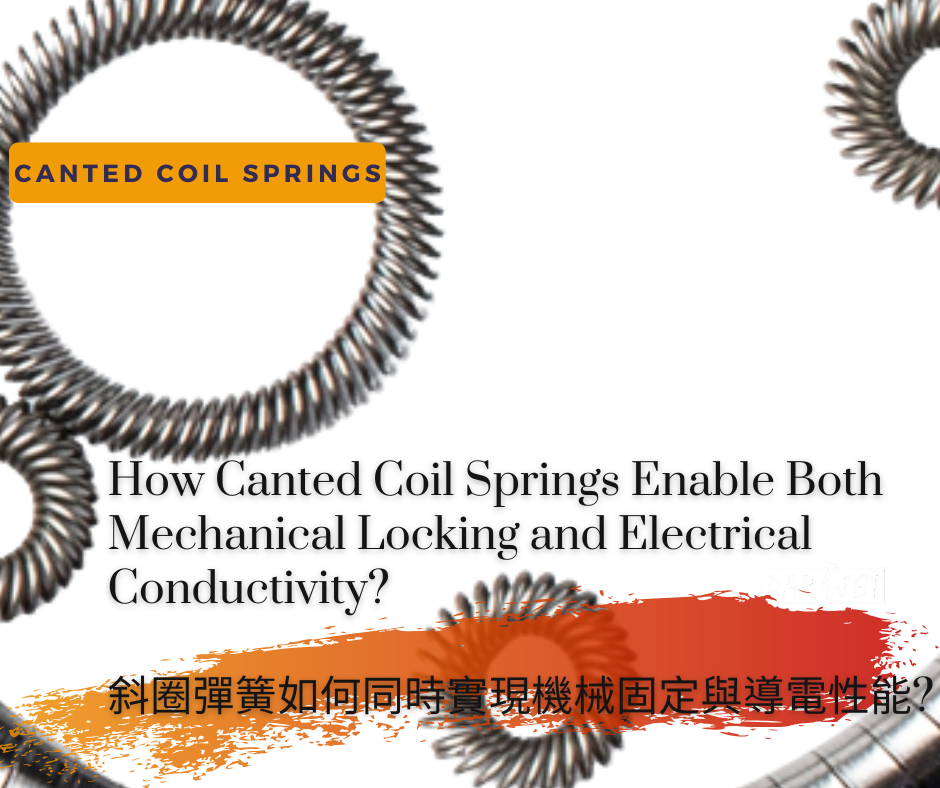
How Canted Coil Springs Enable Both Mechanical Locking and Electrical Conductivity?
How Canted Coil Springs Enable Both Mechanical Locking and Electrical Conductivity?
In high-precision engineering, few components combine mechanical and electrical performance as effectively as the canted coil spring. Known for its unique deflection behavior and long-term stability, this spring design has become a trusted solution in industries ranging from semiconductors and aerospace to medical devices and renewable energy systems.
Unlike conventional coil springs or compression springs, canted coil springs (sometimes called slanted coil springs, cantilevered coil springs, or spring contacts) are designed with coils that are intentionally angled to the spring axis. This geometry allows the spring to deliver a nearly constant load throughout its working deflection range, enabling functions that go far beyond traditional energy storage.
Today, they play a dual role: providing mechanical retention and locking, while simultaneously ensuring electrical conductivity between mating components.
The Engineering Behind Canted Coil Springs
A canted coil spring is essentially a precision-engineered metallic coil in which each turn is tilted at a controlled angle. This design gives the spring several distinct mechanical properties:
- Constant Force Output – The canted geometry allows for predictable force-deflection behavior, providing uniform contact pressure even under vibration or dimensional variations.
- Low Friction and Wear – When used inside sealing or electrical systems, its smooth deflection minimizes friction, preventing galling and extending service life.
- Elastic Recovery – After repeated compression cycles, the spring retains its shape and force characteristics, which is critical for long-term reliability.
These characteristics make it ideal not only for spring-energized seals, but also for electrical connectors, mechanical latching systems, and EMI/RFI shielding assemblies where consistent performance over time is non-negotiable.
Mechanical Locking: Secure, Repeatable, and Maintenance-Free
In assemblies that require components to stay locked in place under vibration, shock, or thermal cycling, canted coil springs provide a mechanical interlocking mechanism that combines flexibility with holding power.
When installed between two mating parts, such as a male and female groove, the spring compresses slightly, exerting a uniform radial force that resists separation. Unlike rigid locking mechanisms that rely on friction alone, the spring’s elasticity accommodates manufacturing tolerances and thermal expansion, ensuring stable engagement even under variable loads.
This principle is used in:
- Quick-Connect Couplings and Retention Systems – The spring provides a snap-in, self-retaining function while still allowing tool-free disassembly.
- Medical and Aerospace Connectors – Where repeated coupling and decoupling cycles require a durable, fatigue-resistant mechanism.
- Vacuum and Cryogenic Equipment – The spring’s constant force ensures reliable sealing and locking, even when materials contract at low temperatures.
For mechanical designers, canted coil springs offer an elegant alternative to screws, pins, or clips—reducing assembly complexity and improving maintainability.
Electrical Conductivity: Precision Meets Performance
One of the lesser-known advantages of canted coil springs is their ability to function as conductive elements. When manufactured from conductive materials such as beryllium copper (BeCu), stainless steel, or nickel-plated alloys, these springs provide low-resistance electrical paths between two surfaces.
The spring’s multiple contact points ensure uniform current distribution, minimizing localized heating and contact degradation. This makes them indispensable in:
- Semiconductor Equipment – For grounding and electrostatic discharge (ESD) protection in wafer handling systems.
- Aerospace & Defense – In shielding applications that require reliable EMI/RFI suppression in compact assemblies.
- Energy Systems & EVs – For power transfer or signal continuity in connectors subjected to vibration or temperature fluctuations.
As the demand for miniaturization grows, canted coil conductive springs deliver stable performance without sacrificing mechanical integrity.
Material Options and Surface Treatments
The performance of a canted coil spring is strongly influenced by its material composition and surface finish. Leading canted coil spring manufacturers, such as Ivex Engineering, offer multiple material options to match customer requirements:
- Beryllium Copper (BeCu) – Excellent electrical conductivity, high fatigue strength, and corrosion resistance.
- Stainless Steel (302, 316, 17-7PH) – Preferred for mechanical retention and chemical resistance in harsh environments.
- Inconel X-750 / Elgiloy® – Used for extreme temperature and corrosive environments.
Surface finishes such as nickel, gold, or tin plating can further enhance conductivity, corrosion resistance, and contact stability. The choice of coating depends on the operating environment and desired electrical properties.
Customization and Design Integration
Every application demands a slightly different combination of load, deflection, and electrical characteristics. Ivex’s engineering team collaborates with customers to design custom canted coil springs optimized for their specific use cases. Parameters such as wire diameter, coil angle, spring force, and material hardness can be fine-tuned to achieve the desired performance envelope.
Typical integration examples include:
- Spring energizers for sealing solutions
- EMI shielding rings for semiconductor and aerospace housings
- Contact springs in battery connectors or power transmission assemblies
- Locking elements in medical quick-connect fittings
Through precise modeling and testing, Ivex ensures that each spring meets or exceeds the functional and environmental requirements of the target system.
Why Choose Ivex as Your Canted Coil Spring Manufacturer
Choosing the right partner is as important as selecting the right spring. Ivex Engineering stands out as a dedicated canted coil spring manufacturer with in-depth knowledge of both mechanical retention and electrical contact engineering.
- In-House Design & Tooling – Complete control over every production step ensures consistent force and geometry.
- Material Expertise – Advanced knowledge of high-performance alloys and surface treatments.
- Testing & Validation – Load, fatigue, and electrical resistance tests confirm real-world performance.
- Application Support – Our engineers assist with integration into seals, connectors, and EMI shielding systems.
This vertical integration allows Ivex to deliver prototypes quickly and scale to full production while maintaining strict quality control.
Conclusion
From mechanical locking to electrical conductivity, the canted coil spring bridges two engineering worlds of precision mechanics and advanced electronics. Its unique geometry, material flexibility, and constant-force characteristics make it a cornerstone component in modern industrial design.
Whether you’re developing a spring-energized sealing system, an EMI shielding connector, or a high-reliability mechanical retention device, Ivex Engineering provides the expertise, materials, and production capability to bring your design to life.
For more information or to discuss your specific application, contact Ivex Engineering , your global partner in custom canted coil spring solutions.