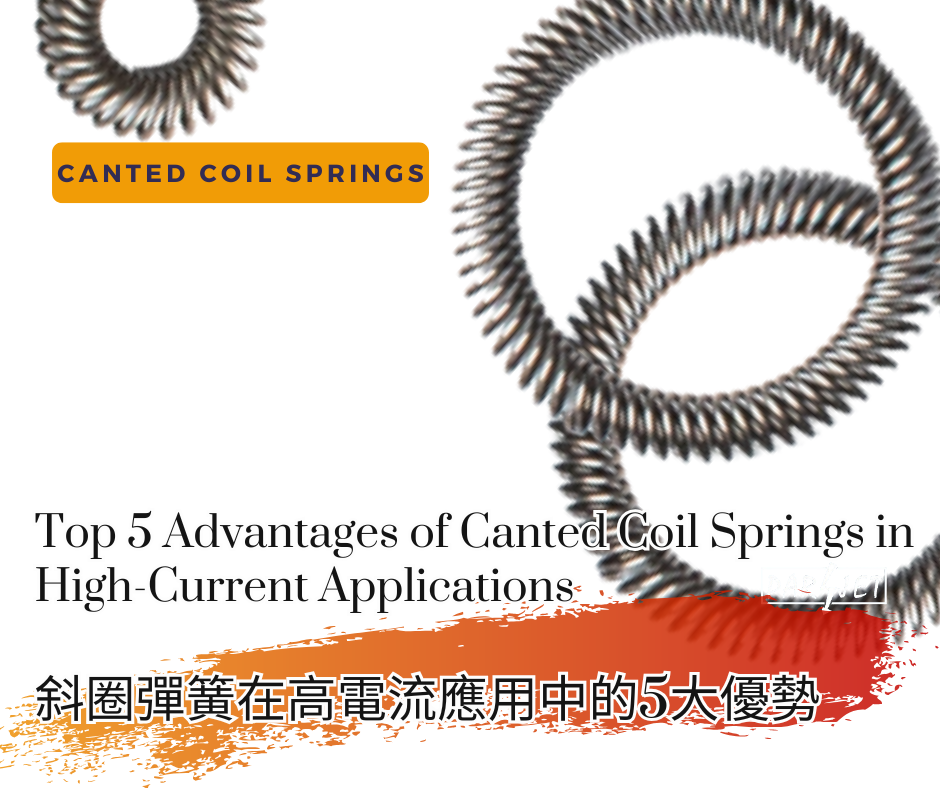
Top 5 Advantages of Canted Coil Springs in High-Current Applications
Top 5 Advantages of Canted Coil Springs in High-Current Applications
High-current systems demand more than simple mechanical retention. In applications such as EV battery connectors, power distribution modules, industrial power equipment, and high-performance charging interfaces, maintaining stable contact force and electrical continuity under thermal and mechanical stress is critical.
Traditional spring designs often struggle in these environments due to force instability, relaxation, or vibration-induced degradation. This is why engineers increasingly turn to canted coil springs for high-current applications.
Below are the five key advantages that make canted coil springs a superior choice in high-power electrical systems.
1. Near-Constant Force for Stable Electrical Contact
One of the most important characteristics of canted coil springs is their near-constant force output across a wide deflection range.
Unlike conventional helical compression springs that produce a linear force increase with deflection, canted coil springs deliver a relatively flat force curve. This provides:
-
Stable contact pressure across dimensional variations
-
Reduced risk of overloading conductive surfaces
-
Improved tolerance compensation
-
Consistent electrical resistance
In high-current applications, fluctuating contact force can lead to increased resistance, localized heating, and long-term degradation. A stable force profile directly supports electrical reliability and system longevity.
2. Superior Performance Under Thermal Expansion
High-current systems generate heat. Thermal cycling is unavoidable.
As conductive components expand and contract, maintaining proper contact pressure becomes a major engineering challenge. Canted coil springs are particularly effective in compensating for:
-
Radial and axial thermal expansion
-
Material mismatch between mating components
-
Dimensional stack-up under temperature variation
Because the spring geometry distributes stress evenly, canted coil springs exhibit lower relaxation rates compared to many traditional spring types. This helps maintain consistent performance even after repeated temperature cycles.
For power electronics and EV battery systems, this thermal stability is a key reliability factor.
3. Enhanced Electrical Conductivity and Multiple Contact Points
Electrical continuity is critical in high-current environments. Canted coil springs offer structural advantages that support improved conductivity:
-
Multiple contact points along the mating interface
-
Uniform pressure distribution
-
Reduced localized current concentration
When manufactured from high-conductivity materials such as beryllium copper (BeCu), canted coil springs provide reliable current paths while maintaining mechanical resilience. Alternative materials such as stainless steel or high-performance alloys can be selected when corrosion resistance or extreme temperature stability is prioritized.
This flexibility allows engineers to balance electrical performance and environmental durability.
4. Improved Resistance to Vibration and Fretting Wear
High-current systems are often deployed in dynamic environments, including transportation platforms and industrial machinery. Mechanical vibration can cause micro-movement at contact interfaces, leading to:
-
Fretting wear
-
Oxidation buildup
-
Increased contact resistance
-
Gradual force degradation
The geometry of canted coil springs allows for controlled elastic deflection in multiple directions, helping absorb vibration without losing contact force. Compared to rigid or highly linear spring designs, this compliance improves long-term durability under mechanical stress.
For engineers concerned with vibration-induced electrical failure, this advantage is significant.
5. Customizable Geometry for High-Power System Requirements
High-current applications rarely follow a one-size-fits-all design model. Engineers must consider:
-
Required current capacity
-
Available installation space
-
Target force range
-
Environmental exposure
-
Fatigue life expectations
Canted coil springs can be customized in terms of:
-
Coil angle and configuration
-
Wire diameter
-
Material selection
-
Heat treatment process
-
Surface finish
This design flexibility allows optimization of force output, conductivity, corrosion resistance, and lifecycle performance. In high-power systems where reliability margins are tight, customization is often necessary rather than optional.
Why Engineers Specify Canted Coil Springs in High-Current Systems
When comparing spring technologies for high-current applications, engineers prioritize:
-
Stable contact resistance
-
Thermal cycling durability
-
Vibration tolerance
-
Long-term force retention
-
Electrical reliability
Canted coil springs address each of these concerns through geometry-driven force control and material adaptability.
Rather than acting solely as mechanical components, they function as engineered force-management elements within electrical systems.
The Ivex Advantage in High-Current Spring Design
Selecting the correct spring for a high-current application requires more than choosing a standard catalog part. It requires understanding force behavior, thermal response, and electrical performance as a system.
Ivex specializes in custom canted coil spring solutions for demanding electrical applications. Our engineering capabilities include:
-
Force-deflection curve analysis
-
Finite element simulation for stress and thermal behavior
-
Material evaluation for conductivity and fatigue resistance
-
Precision tolerance control
-
Repeatable heat treatment process management
By collaborating directly with design engineers, Ivex develops application-specific spring solutions optimized for high-current environments.
Final Thoughts
High-current applications place unique mechanical and electrical demands on contact systems. Instability in force, thermal expansion, or vibration can quickly compromise performance.
With near-constant force characteristics, strong thermal resilience, enhanced conductivity, vibration tolerance, and customizable design options, canted coil springs provide a reliable solution for high-power electrical systems.
When electrical performance and mechanical durability must coexist, properly engineered canted coil springs offer a measurable advantage.
If you are developing a high-current system and evaluating spring technologies, the Ivex engineering team is ready to support your design process.