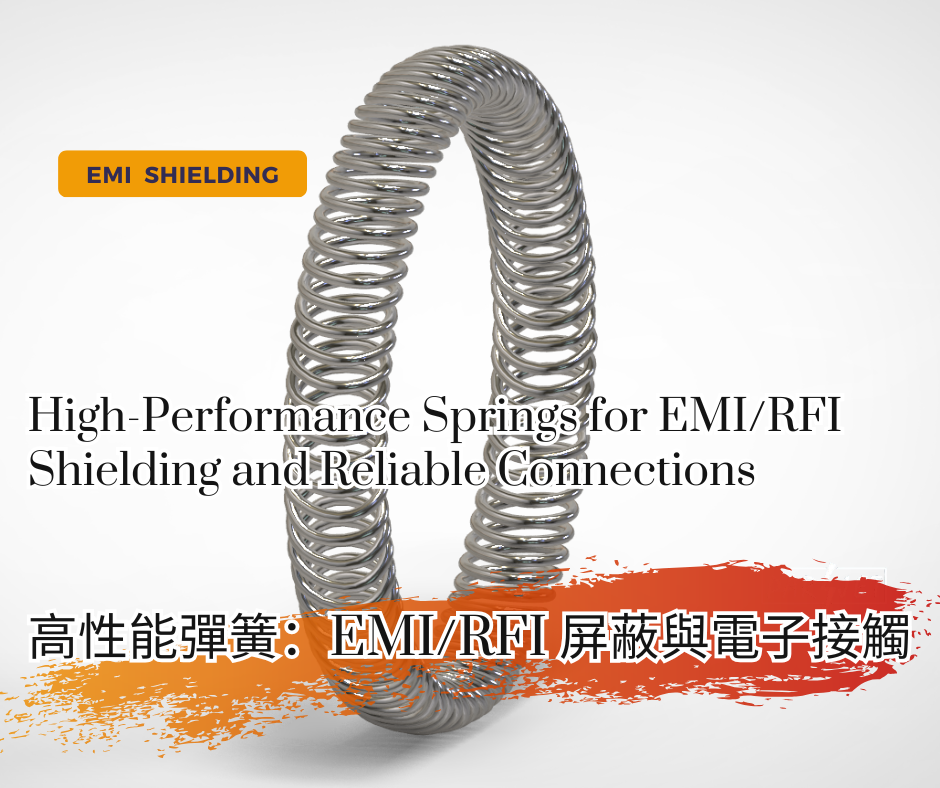
High-Performance Springs for EMI/RFI Shielding and Reliable Connections
High-Performance Springs for EMI/RFI Shielding and Reliable Connections
Design engineers in electronics, aerospace, and defense face demanding requirements for connectors and enclosures: managing EMI/RFI interference, ensuring stable electrical contact, and resisting vibration and shock. High-performance spring elements like canted coil springs, helical compression springs, and cantilever (leaf) springs are proven solutions for these challenges. These specialized springs provide reliable connector retention, predictable insertion/removal forces, tight tolerance compensation, and consistent load across temperature variations.
Key design challenges include:
-
EMI/RFI Shielding: Springs often double as conductive gaskets or contacts to block interference, replacing bulky metal frames or soldered wires.
-
Stable Electrical Contact: Maintaining low-resistance connections under mating cycles and vibration requires springs with precise force and high conductivity.
-
Vibration and Shock Resistance: Springs should absorb mechanical shocks and compensate for misalignment, protecting sensitive circuitry.
-
Tight Tolerances: Small dimensional variations (connector gaps, housing misalignment) must be taken up by spring compliance without loss of contact force.
-
Thermal Consistency: Materials must retain spring force across extremes (e.g. –40°C to +125°C) without permanent set.
-
Connector Retention & Insertion: Spring geometry dictates the force required to mate or unmate connectors. Engineers balance insertion force with retention (hold) force for reliable latching.
-
Durability and Fatigue Life: Contacts and springs see millions of cycles in service, so alloy yield strength and stress‐relaxation properties are critical to avoid force decay.
Canted Coil Springs: EMI Shielding & Compliance
-
Multiple Contact Points: Canted coil springs (also called slanted or fiber springs) have each coil tilted to create many independent metal-to-metal contact points. This multi-point design provides an excellent conductive path for EMI/RFI grounding. The angled coils flex to maintain contact across mating surfaces even under shock and vibration.
-
Broad Deflection Range: These springs deliver near-constant force over a wide deflection range. They resist compression set and their individual coils compensate for tolerance stack-ups and surface irregularities. As a result, shielding performance stays consistent even when temperatures vary.
-
Lightweight Shielding: Canted coils can serve as spring gaskets between plug connectors or around cable shields. They offer a flexible, low-profile conductive seal, useful in weight- or space-constrained aerospace and handheld devices.
-
Easy Integration: Canted coils install easily (often as custom lengths or welded rings) with no additional hardware required. This simplifies assembly and reduces development cost, since the spring can be dropped into existing grooves or gaps without redesigning complex structure.
Helical Springs: Flexible Shielding and Force Compliance
-
Spiral EMI Shielding: Compression helical springs made from conductive alloys act as spiral EMI/RFI shields. Each turn reflects and absorbs interference, providing high attenuation. Plating the spring (e.g. silver or gold) can further improve conductivity and shielding performance.
-
Axial Compliance: The coil geometry yields predictable compression force. By choosing wire diameter, coil count and material, engineers set insertion force and contact pressure precisely. This control helps achieve low insertion force for ergonomics while still meeting retention needs. Helical springs also maintain flexibility and toughness in service.
-
Durable Materials: Common materials include copper alloys (for conductivity) and stainless steels (302/316 for strength). Stainless steel springs provide a higher force-per-volume than copper and are often plated to enhance conductivity. With corrosion-resistant coatings (nickel, tin, etc.), these springs withstand harsh environments while serving as efficient contacts.
-
Broad Usage: Helical spring contacts appear in many connectors (e.g. board-to-board and RF connectors) where both EMI suppression and spring compliance are needed. Their compact, symmetrical shape fits well in cylindrical housings or RF cavities, and multiple springs can be stacked for added force.
Cantilever Springs: Targeted Contact and Retention
-
Precise Contact Force: Cantilever springs (leaf, U- or V-shaped) act as one-sided contacts in connectors. They deliver a consistent normal force at a specific mating point, ensuring reliable electrical connection in switches, PCB sockets and plug interfaces. The cantilever design inherently dampens vibration, keeping contacts stable under mechanical shock.
-
Predictable Deflection: A fixed end and free end give a well-defined spring curve. Designers exploit this for tight force control – a shorter beam yields higher force, a longer beam lower force – making it straightforward to meet retention or ejection requirements. Multiple cantilever springs can be arranged or layered to adjust force linearly if needed.
-
Durability & Longevity: Properly designed cantilevers resist fatigue over millions of cycles. High-quality materials and stress-relief processes ensure long fatigue life. For example, correctly treated spring alloys (like copper beryllium or Elgiloy) maintain spring force without significant set through extensive service.
-
Space-Efficient Form: Cantilever springs fit into very tight spaces (like edge cards or battery clips) without bulky profiles. Their flat or curved strip shapes can also serve as retaining clips. With custom stamping or etching, springs can include notches or pivots for specialized latching mechanisms.
-
Environmental Suitability: Engineers select materials based on conditions. Stainless steels are used where corrosion or high temperature are concerns; copper alloys (phosphor bronze, BeCu) where conductivity and wear matter. In extreme environments, high-alloy materials like Elgiloy can be chosen for maximum strength and stability.
Spring Materials: Strength, Conductivity, and Stability
-
Stainless Steel (302/316): Offers excellent corrosion resistance and high strength. Stainless springs can be heat-treated for fatigue strength and are often used where mechanical robustness is critical. However, stainless has lower conductivity, so springs are frequently plated (silver, tin, etc.) to reduce contact resistance.
-
Beryllium Copper (BeCu): A top choice for contact springs and EMI gaskets. BeCu combines high yield strength, good fatigue endurance, and superb electrical conductivity. It resists stress relaxation (so contacts stay “springy”) and maintains performance over wide temperature ranges. Plated BeCu springs provide low insertion force and very long cycle life.
-
Elgiloy (Ni-Co-Cr Alloy): Used where maximum fatigue life and corrosion resistance are needed. Elgiloy springs have fatigue strength well above stainless steel and retain their spring force at very high or low temperatures. This premium alloy is ideal for aerospace or medical connectors that must endure extreme conditions.
-
Other Copper Alloys: Phosphor bronze and Cu-Zr alloys are common for moderate-demand contacts (good conductivity and strength). These can be plated as needed for specific conductivity or corrosion requirements.
-
Platings and Coatings: Fine metal platings (gold, silver) or surface coatings (nickel, tin) enhance contact performance. Silver plating is often used for maximum conductivity, while gold prevents oxidation. Such protective coatings boost corrosion and wear resistance, ensuring stable long-term spring performance.
Custom Spring Engineering and Ivex Support
At Ivex, we understand the intricate balance of electrical, mechanical, and environmental requirements for high-performance springs. Our engineering team collaborates with you to tailor springs for your connector or shielding application. We offer:
-
Custom Design & Simulation: Defining spring geometry, wire size, and material to meet target insertion force, retention, and shielding performance. Finite-element analysis and prototyping verify spring curves and contact pressures before production.
-
Material Selection: Advising on the best alloy and plating (e.g. BeCu vs stainless, or silver vs tin plating) to achieve required conductivity, fatigue life, and corrosion resistance.
-
Prototype Validation: Building samples and conducting tests (force-deflection, thermal cycling, insertion/extraction, fatigue) to ensure the spring meets specifications for connector retention and contact stability.
-
Precision Manufacturing: Our production methods hold tight tolerances on coil dimensions and wire diameter. We can deliver complex shapes (welded rings, stamped blades, helical forms) and apply MIL-spec coatings. This guarantees each spring provides consistent force and conductivity in your assembly.
-
Quality Assurance: Every batch is inspected for dimensional accuracy, plating quality, and spring constant. Traceability and certifications (e.g. RoHS, MIL standards) are available to meet your compliance needs.
Take the next step: For reliable EMI/RFI shielding and connector performance, partner with Ivex’s spring experts. We will work with you from concept to production ramp-up, ensuring your custom canted coil, helical or cantilever spring meets all requirements. Contact Ivex today to discuss your project and get a precision spring solution engineered to your specifications.